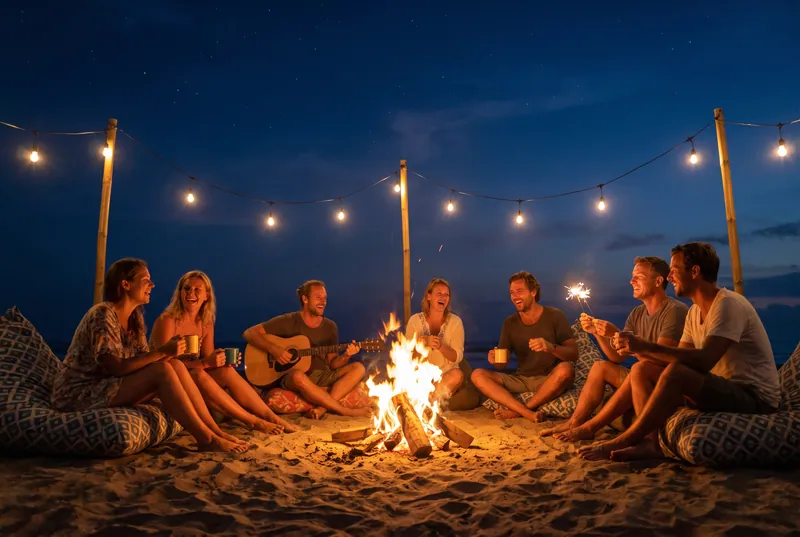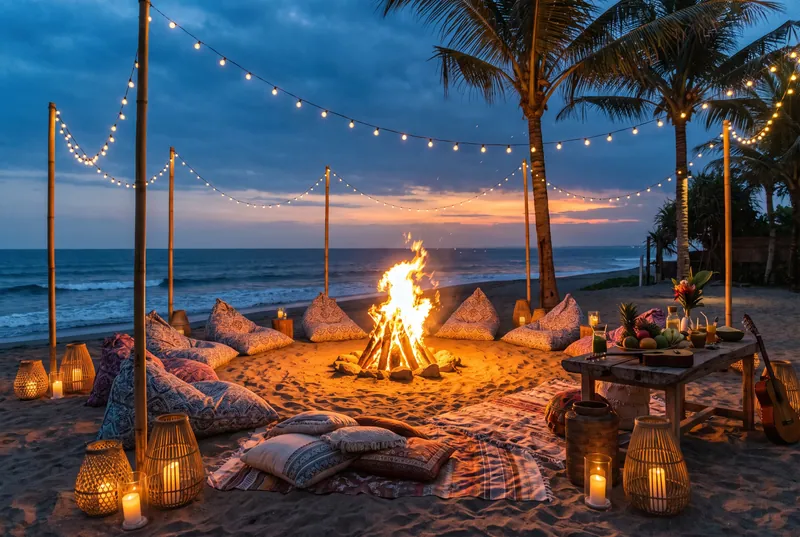
There’s a version of this evening everyone imagines: a real fire on the sand, a circle of friends on cushions, a guitar or a speaker at civilised volume, and the sky doing its slow post-sunset show over the water. And there’s the version that actually happens when a group tries to build it themselves: a confusing negotiation with a beach guard, firewood that smokes instead of burns, nowhere to sit, and the whole thing shut down by 20:00.
The difference between the two isn’t money — it’s process. Beaches in Bali are managed by the banjar, the local community council, and a fire on their sand without their blessing is the fastest way to meet them in the wrong mood. This page explains how the legal version of a beach bonfire in Bali works, what it costs, and how we build it into a proper beach party for groups of anywhere from two to forty.
Is a beach bonfire in Bali legal?
Short answer: yes, with permission — and that permission is local, not national. Every stretch of sand on the island falls under a banjar, the neighbourhood community that manages its territory, and any organised beach use — a fire, a seating setup, tables of food — runs through them, usually with a community fee attached.
This is the single most important thing to understand about the format. There is no central permit office you can email; there are dozens of banjars with their own rules, their own fees and their own relationships. Some beaches allow fires readily in the dry season, some only in certain zones, and some — especially the hotel-fronted stretches of Nusa Dua — effectively don’t allow them at all. The workable answer shifts with the season, the tide line and, frankly, how the last group behaved.
That’s the real service we sell. We work with banjars we already know, pay the proper fees openly, agree the exact spot and end time in advance, and have the permission question answered before your group ever walks onto the sand. If a guard approaches your party, the answer is “it’s arranged with the banjar” — and it’s true. What we won’t do is build an unpermitted fire and hope: the realistic outcome is losing your evening halfway through, and it would burn a community relationship we rely on every month. For the full breakdown of how permissions and fees work, our guide to bonfire permits and costs goes deeper.
What a bonfire party setup includes
- The fire itself — properly dry firewood (far more than you’d think: a three-hour fire eats a small mountain of it), a safe pit arrangement above the tide line, and someone tending it all evening so it burns instead of smokes. Marshmallows for toasting come standard, because adults deserve them too.
- Seating and styling — bean bags, cushions and low tables in a circle, bamboo torches marking out your space, lanterns or fairy lights, and blankets for later. Yes, blankets: the beach gets breezy after dark, especially in July and August.
- Permissions and fees — banjar coordination, community fees paid properly, and an agreed end time and noise level, so nothing about the night is improvised.
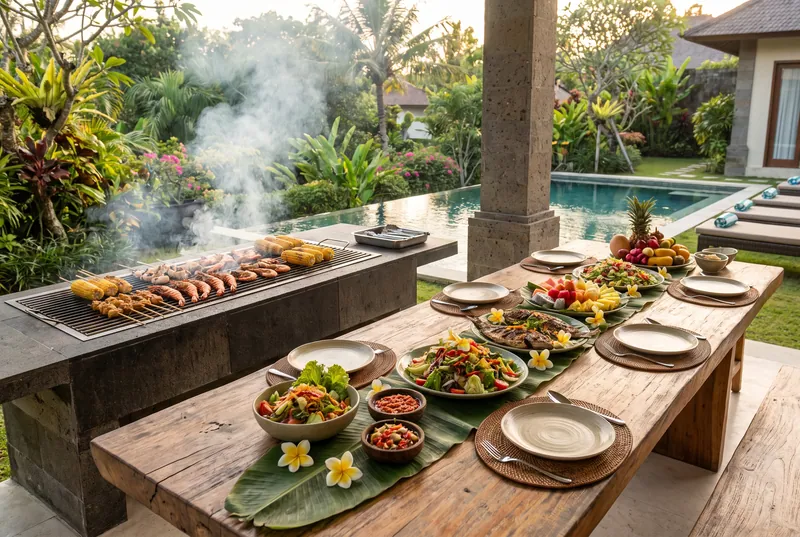
- Food and drink service — from a grazing spread to a live grill running beside the fire, with staff serving so nobody spends the party holding tongs.
- Cleanup — we leave the sand the way the banjar expects it: as if nobody was there. It’s non-negotiable, and it’s why we’re welcome back.
Food around the fire
The natural pairing is a live grill. Our BBQ party crew sets up beside the bonfire, with market rates from IDR 250,000 per person for a solid grill menu, climbing toward IDR 1,200,000 per person if you want wagyu and lobster over the coals. Groups who’d rather graze go for platters — satay skewers, grilled corn, fresh fruit, things that make sense eaten from a plate on your lap — with event catering from around IDR 350,000 per guest.
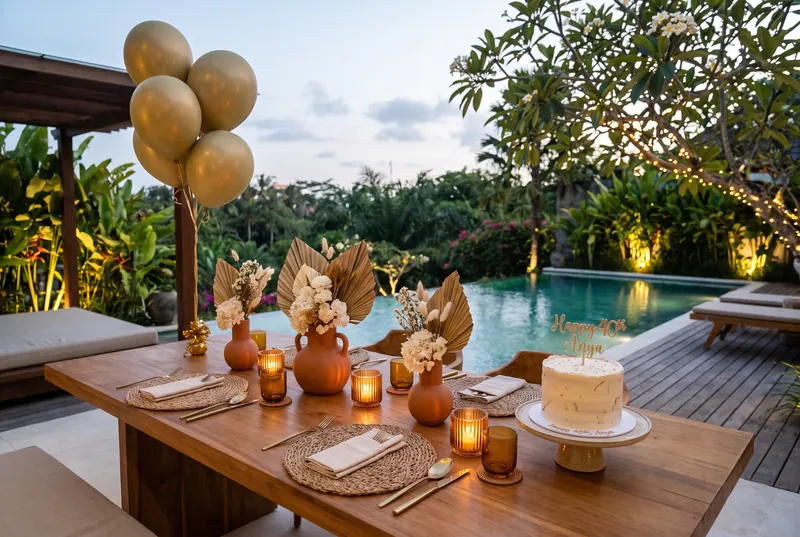
A bonfire is also one of the best birthday settings on the island: the cake comes out at full dark, when candles actually glow, and the fire does the ambience work a villa needs a decorator for. We build that as part of our birthday party organization. And for hens and bucks groups who want something classier than another club night, fire plus grill plus acoustic guitar is exactly the bachelorette and bachelor party format we recommend most often.
Bonfire formats, by what you are celebrating
A fire on the sand is the same fire every time. What changes is everything around it — the timing, the food, the volume and how the evening ends.
Birthday on the beach. The most common request we get. Golden-hour arrival, the fire lit as the light goes, cake brought out in the dark with the flames behind it — that is the photograph people actually want. Works from six guests to about forty before it stops feeling like one group.
Bachelorette and bachelor nights. A bonfire is the good version of a hen or stag evening in Bali: relaxed, photogenic, no venue minimum spend, and it runs straight into a villa after-party when the beach winds down at 22:00.
Wedding after-party. Guests who are done with the formal dinner but nowhere near done with the night. Barefoot, beanbags, a guitar, the same people in a completely different mood. We usually set this up within walking distance of the venue.
Corporate and team evenings. The one format that reliably melts a stiff group — an offsite dinner where nobody is sitting in rank order. For teams of 20 and up we pair it with proper catering and a covered fallback, because a company evening cannot simply be cancelled by a cloud. See corporate events.
Farewell and welcome nights. Long-stay groups leaving the island, or families gathering on day one. Low-key, long, and the easiest evening to say a real goodbye at.
A night with friends, for no reason at all. An underrated format: a group of friends on a Bali trip, one free evening, and the feeling that a restaurant would waste it. A beach bonfire party with friends needs no occasion — fire, BBQ, a speaker at legal volume and three unhurried hours. Groups of 8–15 book this most, usually two days ahead, and it costs less per person than a night out in Seminyak.
Safety, and what actually arrives on the sand
The fire is the part that looks casual and is not. What we bring to every setup:
- A contained fire circle — stones or a metal fire bowl, never an open pile on loose sand, set above the evening waterline and clear of overhanging vegetation.
- Dry, seasoned firewood brought in by us. Beach driftwood is damp, salty and smokes into people's faces; it looks romantic and behaves badly.
- Water and sand buckets at the circle, and staff who stay with the fire the entire evening — the fire is never left to guests.
- A safe seating radius: beanbags and low furniture arranged far enough back that a gust of wind is an inconvenience rather than an incident.
- Lighting beyond the fire — lanterns and festoon lights, because a beach past 19:00 is genuinely dark and the walk back to the cars matters.
- Full extinguish and clear-out. The fire is drowned, not buried — hot sand is how people get hurt the next morning — and the sand goes back cleaner than we found it. This is also the single condition every banjar cares about most.
Two honest notes. Fires are not permitted on every beach or on every date — ceremonial days close some stretches entirely, and we will tell you if yours is one of them. And on windy evenings, usually July and August on the south coast, we build the circle smaller and set the seating further back rather than pretending the wind is not there.
How much a beach bonfire in Bali costs
Every quote is individual, because the beach, the banjar fee and the group size genuinely change the maths. Treat these 2025–2026 figures as indicative:
| Format | Indicative price |
|---|---|
| Bonfire setup (fire, seating, torches, permissions) | quoted per beach — depends on banjar fee and group size |
| BBQ grill alongside the fire | from IDR 250,000 per person |
| Premium BBQ (wagyu, seafood, lobster) | up to IDR 1,200,000 per person |
| Grazing-style event catering | from IDR 350,000 per guest |
| Intimate bonfire dinner for two | from $200 per couple |
| Photographer (1 hour, edited photos) | from ~$100 |
The bonfire setup itself has no flat rate for an honest reason: a fire for eight on a quiet Sanur stretch and a fire for forty on prime Seminyak sunset sand are different events with different community fees. Send us your group size and area on WhatsApp and you’ll get a real number, itemized.
Choosing the beach
We pick the beach around three things: where your group is based, the sunset, and the banjar’s terms. From Seminyak — our home base — the wide western sand around Batu Belig and Double Six ends the day with the sun dropping straight into the ocean between 18:10 and 18:40, any month of the year. Canggu’s dark-sand surf beaches at Berawa and Pererenan have a rawer, more dramatic look and suit groups already staying there — factor in the evening traffic if your villa is elsewhere. Sanur faces east, so there’s no over-water sunset, but its calm, quiet stretches are the most relaxed place on the island for a mellow fire, and the local temperament suits a longer, easier evening. Nusa Dua’s beaches are the strictest — the usual answer there is sand just outside the resort enclave, or a fire bowl in a villa garden instead. And Uluwatu? Spectacular clifftops, but most of its beaches are small coves at the bottom of long stairs that vanish at high tide — beautiful for a sunset drink, wrong for hauling firewood.
Timing, tide and weather
Tide is the detail that makes or breaks a bonfire, because high water at 19:00 can erase the exact sand your fire sits on. We check tide tables before confirming any date and set the circle above the evening waterline. The rhythm that works: guests arrive around 17:00 for golden hour, sunset lands between 18:10 and 18:40, the fire is lit as the light fades, and the party peaks in the two hours after dark. In the dry season, April to October, rain risk is minimal; in the rainy months the showers are usually short and afternoon-weighted, so evening fires still mostly happen — but every booking carries a fallback we agree in advance, usually a covered villa version of the same party. And the evening ends the way it started: on the banjar’s terms, wound down by around 22:00, with the after-party moving to a villa if your group is nowhere near done.
How booking works
- Message us on WhatsApp with your group size, your dates and where you’re staying.
- We propose the beach and the format — two or three options with photos of real setups, menu choices and an itemized quote that includes the community fees.
- We confirm the banjar permission for your specific date and spot, plus the weather fallback.
- You arrive at 17:00. The circle is built, the torches are lit and the grill is warming up; a coordinator stays on site until the fire is safely out.
A deposit locks the date; the balance settles on the day. For groups over twenty, or high-season dates in July–August and around New Year, give us at least a week — the good beaches and the good slots go first. For dates between Christmas and 2 January, start with our New Year party in Bali guide — the island books out by early December.
If a fire on the sand with your people sounds like the right kind of night — message us on WhatsApp and we’ll sort the beach, the banjar and everything in between.