All dry season long my WhatsApp fills with the same question: “Can we actually have a bonfire on a beach in Bali, or will someone come and shut it down?” The short answer: yes, you can — legally, safely and beautifully — if you sort out the local permissions first and treat the beach with respect. The long answer is this guide.
I’ve run beach bonfire evenings for couples celebrating anniversaries, for groups of twelve on their last night of a surf trip, and for a quiet family of four who just wanted marshmallows and stars. Below is everything I wish clients knew before they message me: how the permits really work, which beaches suit a fire, how season, wind and tide change the plan, what a proper setup includes, and what a beach bonfire in Bali costs in real numbers.
Is a beach bonfire in Bali even legal?
This is the part most blog posts get vague about, so let me be specific. Beaches in Bali are public space, but they are looked after by the banjar — the local community organization of the village that beach belongs to. The banjar decides what happens on its sand: vendors, events, ceremonies, and yes, bonfires. An open fire with seating, decor and a group of guests is an event, and it needs the banjar’s permission, which usually comes with a fee.
That fee varies by beach, group size and what you’re setting up — there is no single published price list, which is exactly why we include the permission and the fee inside every itemized quote. What I can tell you from experience: the cost of doing it properly is modest, and the cost of not doing it is your party being shut down mid-evening in front of your guests.
One more layer: some stretches of sand — especially in Nusa Dua and in front of resorts — are managed more strictly by the hotels that front them. A bonfire there needs the hotel’s sign-off too, and some simply won’t allow open fire. We check before promising anything.
My rule is simple: never just show up with firewood. We work with the banjars regularly, they know our setups are clean and safe, and that relationship is why our fires happen smoothly.
Which beaches work for a bonfire party
Not every beautiful beach is a good bonfire beach. Here’s the honest area-by-area picture.
Seminyak — wide, west-facing sand at Double Six and Batu Belig with the sunset directly over the water. Easy access from most villas and hotels, which keeps logistics cheap and guests punctual. These beaches are lively, so we set up away from the main crowds and let the fire create its own island of privacy.
Canggu — dark volcanic sand, surf breaking in the background, a younger, barefoot mood. Berawa, Batu Bolong and Pererenan all work well. The one factor to plan around is evening traffic: getting to the beach at 17:30 through Canggu can take longer than you think, so we tell groups to leave earlier than feels necessary.
Sanur — the calm east coast: gentle water, a relaxed older crowd, and generally easygoing local rules. You trade the sunset-over-ocean view for stillness and space, and for many groups that trade is worth it. It’s also the ferry hub toward Nusa Penida, so a bonfire here pairs neatly with a boat day.
Nusa Dua — groomed resort sand and calm water, but the strictest permissions on the island because hotels control most beach frontage. Doable for guests staying inside the enclave; we confirm the exact spot with the resort first.
Uluwatu — I love the cliffs, but the famous beaches sit below them, down long stairways. Carrying firewood, furniture and catering down (and back up, at night) makes this the most logistics-heavy option, and several coves shrink to nothing at high tide. Possible for the determined; for most groups I steer the bonfire to Seminyak or Canggu and save Uluwatu for dinners on the cliff instead.
Season, wind and tide: timing it right
Three natural forces decide how good your bonfire night is, and all three are predictable if someone bothers to check.
Season. The dry season, roughly April to October, is bonfire prime time — reliably clear evenings and starry skies. The wet season (November to March) doesn’t rule fires out: Bali rain typically comes in short, heavy bursts, most often in the afternoon or early evening, and clears. We watch the radar on the day, keep a plan B agreed in advance, and shift timing when needed.
Wind. In July and August the south coast gets properly gusty by late afternoon. Wind and open fire need respect: we size the fire down, orient the seating upwind of the smoke, put every candle and lantern in glass, and anchor anything light. A windy-night bonfire can still be wonderful — it just has to be built by someone who expected the wind.
Tide. The beach you saw at noon is not the beach you’ll get at 19:00. High tide can swallow most of the dry sand on some stretches, pushing your whole setup against the wall of beach clubs. We check the tide tables for your exact date before confirming the spot — a two-minute check that saves the entire evening.
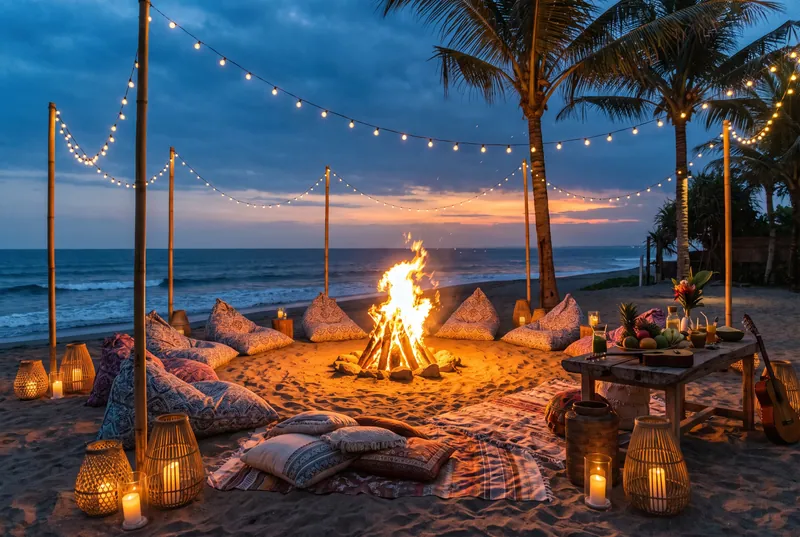
And the golden detail: sunset lands between roughly 18:10 and 18:40 all year round. We light the fire just after the sun goes down, so the flames take over exactly as the sky fades — the handover from sunset to firelight is the moment everyone photographs.
Safety, done properly
An open fire on a public beach is only romantic when it’s boringly safe. Our standard practice: the fire sits in a dug pit or raised fire bowl with a generous clear radius from all seating; water and sand are staged next to it before the first match; and one member of our crew tends the fire the entire evening — feeding it, watching the wind, managing sparks. We keep sensible distance from boats, beach beds and vegetation, and we never leave until the coals are fully extinguished and removed. At the end of the night the goal is simple: the banjar should find their beach cleaner than we found it. That’s not just ethics — it’s why we keep being welcome.
If you’re dreaming of fireworks or flying lanterns, ask us separately — different rules apply, and on many beaches the honest answer is no.
What’s included in a bonfire setup
A proper beach bonfire party in Bali is more than a pile of burning wood — the full format lives on our beach bonfire party service page, but here’s the anatomy. The base setup we bring: the fire itself with enough seasoned wood for the whole evening, a seating circle of bean bags, rugs and low tables, lanterns or bamboo torches for ambient light, and simple decor to make it feel styled rather than improvised. Setup happens before you arrive; breakdown and cleanup after you leave.
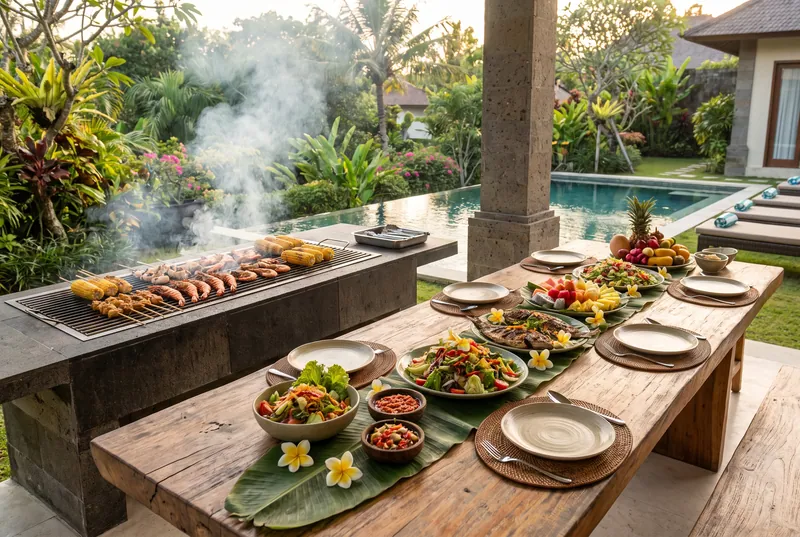
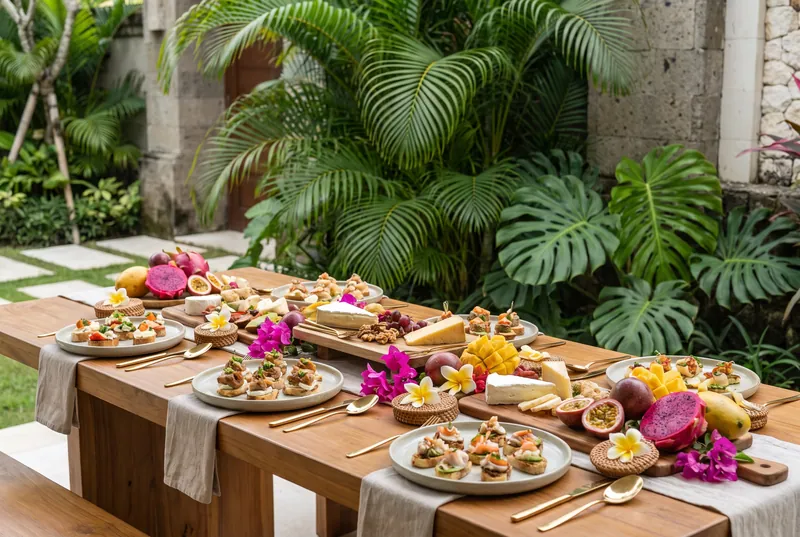
From there, you build the evening you want. The most popular add-on by far is a grill dinner — our BBQ party service runs from around IDR 250,000 per person and works beautifully next to a fire. Bigger groups sometimes go for full event catering with staff. Add an acoustic guitarist, a photographer, or a s’mores round for dessert — marshmallows over a Bali bonfire never fail, whatever the average age of the group. For couples, we style a quieter version: one fire, one low table, dinner for two — a bonfire cousin of our romantic dinner setups.
One honest note on music: beaches have neighbours and banjar rules. Acoustic levels are fine almost everywhere; a DJ rig on public sand usually isn’t. If your group wants a proper party soundtrack, a villa is often the better venue after the fire.
What a beach bonfire in Bali costs
Indicative 2025–2026 numbers — every real quote is itemized, with the banjar fee for your specific beach included:
| Format | Indicative price |
|---|---|
| Intimate bonfire dinner setup for two | from $200 per couple |
| Bonfire party with BBQ dinner | from IDR 250,000 per person |
| Full event catering for larger groups | from IDR 350,000 per guest |
| Photographer | from ~$100 per hour |
What moves the total: group size (more seating, more food, bigger fire), the beach itself (permit costs and transport distance differ), and how far you take the styling and menu. Prices are indicative — we confirm exact numbers on WhatsApp before you commit to anything.
How booking works
- Message us on WhatsApp with your date, group size and where you’re staying — “somewhere near Canggu, about ten people, last night of the trip” is a perfectly good brief.
- We propose the beach and the setup, with photos of real fires and an itemized price. At this stage we’re already checking banjar availability and the tide table for your date.
- We lock the details — menu, timing, music, extras — and secure the permission.
- You arrive at sunset. The circle is built, the fire is ready to light, our crew runs it all evening, and the beach is spotless by midnight.
A few last tips from someone who’s built a lot of fires
Come barefoot but bring a light layer — the breeze after 21:00 is real, even in the dry season. Trust the fire to do the entertaining: groups that plan wall-to-wall activities always abandon them once the flames get going. Time dinner before dark so the grill crew works in light and you eat at golden hour. And if there’s a proposal hiding inside your bonfire plan — tell us; firelight is criminally underrated for that question.
If a fire on the sand sounds like your kind of evening — message us on WhatsApp with your date and group size, and we’ll figure it out together.